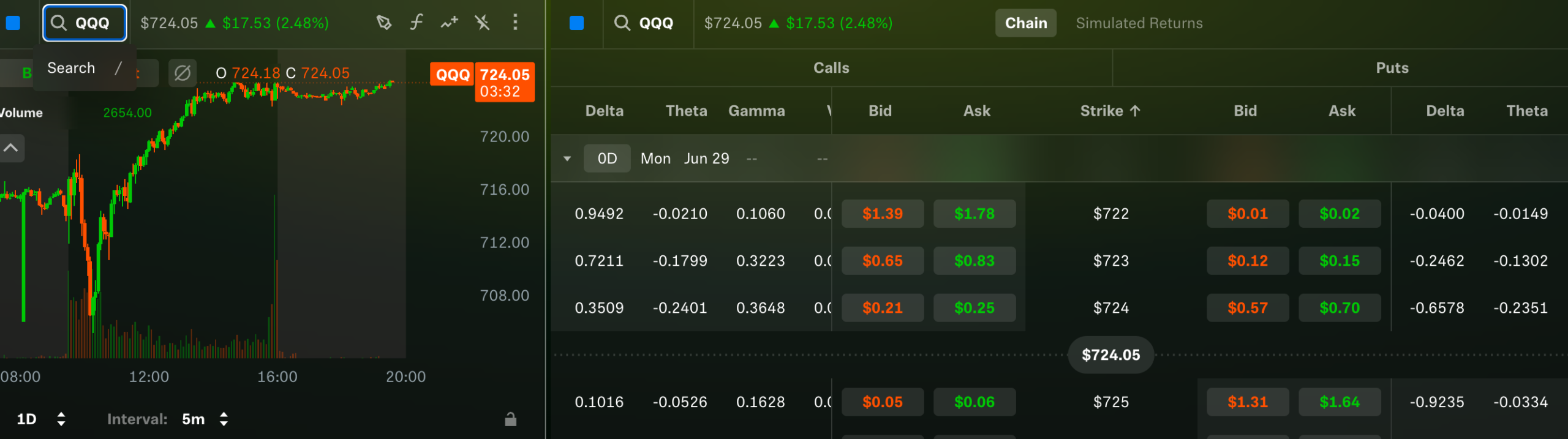
Hello, fellow traders. Today, I want to share my practical, battle-tested blueprint for trading 0DTE Options, a topic that has recently taken the trading community by storm.
With the recent shifts in leverage and execution accessibility for retail accounts, the barriers to entry have practically vanished. Now, retail traders with smaller capital can trade multiple times a day without being heavily restricted. Because of this, we are seeing a massive influx of retail investors looking for fast, intraday returns through 0DTE Options.
However, lower barriers to entry always come with amplified risks. To help you navigate these volatile waters, I am opening up my personal, real-world trading methodology. If you are just starting out, sticking to these guidelines will protect you from catastrophic blown accounts and set you on a path to consistent execution.
1. The Non-Negotiable Rule: Delta Selection for 0DTE Options
The absolute first rule you must imprint on your trading brain—as I emphasized in my previous post—is that buying deep out-of-the-money (OTM) options on a 0DTE Options contract is a recipe for disaster.
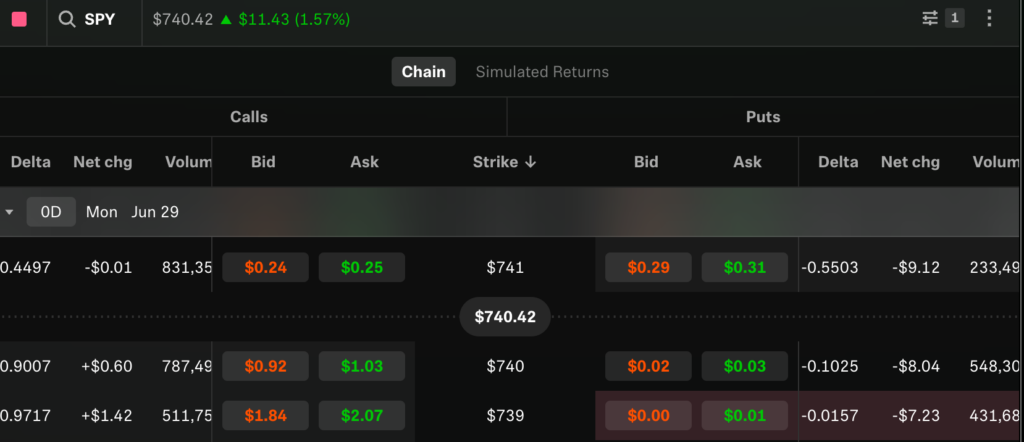
Your initial trades must never be OTM. Instead, strictly stick to At-The-Money (ATM) or In-The-Money (ITM) contracts with a Delta (\delta) of 0.50, 0.60, 0.70, or 0.80. Starting in these premium zones ensures that even if the market moves slightly against you, the intrinsic value protects you from immediate, hundred-percent premium wipeouts. Whether you take 1 trade or 10 trades a day, treat this rule as law.
2. Asset Selection: Avoid Low-Float, High-Volatility Mid/Small-Caps
While technically you can trade options on any ticker, you should completely stay away from highly volatile, low-liquidity mid and small-cap stocks. The bid-ask spreads will eat you alive.
Personally, I heavily focus on large-cap indices and highly liquid vehicles like SPY and QQQ. The reason is simple: the volume is massive. Massive volume means hyper-tight spreads, allowing you to enter and exit positions instantly with near-zero slippage.
3. [The Step-by-Step Process] Step 1: Pre-Market Analysis (1 Hour Before Open)
My routine begins exactly one hour before the opening bell. I power up my setup, scan the morning macro news, and analyze how the price action moved during the pre-market session.
The goal here is to identify which sector is going to lead the market today. Monitoring sector-specific ETFs is an incredibly efficient way to gauge this flow. I always check the relative strength or weakness of:
- SMH / SOXX: Semiconductors
- XLK: Technology
- IGV: Software
- XLV: Healthcare
4. Step 2: The Opening Bell and Multi-Timeframe Observation
When the market opens, I sit on my hands for the first 15 to 30 minutes. This is a mandatory observation period to confirm whether the pre-market momentum is genuinely carrying over into the regular session or if it was a bull/bear trap.
After the 30-minute mark, I pull up my primary watchlists and load up the 1-hour chart and the 5-minute chart simultaneously. The 1-hour chart gives me the macro trend, while the 5-minute chart establishes local support and resistance. Once my setup criteria are met on these higher timeframes, I zoom into the 1-minute chart to micro-manage my exact entry execution.
5. Step 3: My Technical Entry Triggers for 0DTE Options
I never enter a trade based on a single indicator. To pull the trigger, at least 2 or more of the following technical conditions must align simultaneously:
- Opening Range Breakout: The 5-minute candle decisively breaks above or below the high/low established in the first 15 minutes of the session.
- Pre-Market Levels: Price aggressively breaks through the Pre-Market High (PMH) or Pre-Market Low (PML).
- RSI Extremes: The Relative Strength Index (RSI) registers under 30 (oversold) or over 70 (overbought).
- Bollinger Bands: Price tags, stretches, or closes completely outside the outer bands.
- EMA Cross: The 8 EMA and 20 EMA print a clean crossover, indicating a sharp, intraday momentum shift.
6. Step 4: Matching Your Platform to Your Strategy for 0DTE Options
I am frequently asked what platforms I use. While I utilize a multi-broker setup, your choice of platform should strictly depend on your trading speed.
- Webull / Tastytrade: If you are actively scalping 0DTE Options, these platforms are superior. Their order routing is incredibly fast, and their UI allows for precision hot-key execution.
- Robinhood: Excellent UI, extremely user-friendly, and perfect for beginners. However, the order execution and fills can lag during high-velocity moves. If you prefer a more relaxed pace, avoid rapid 0DTE options scalping on Robinhood. Instead, leverage their clean interface for 3 to 7 DTE options, where a few seconds of execution delay won’t make or break your position.
7. Step 5: Singularity — The Power of Single 0DTE Options
While 0DTE Options strategies like Iron Condors, Credit Spreads, and Debit Spreads are fantastic structural tools, I strictly prefer Single Options (naked Calls or Puts) for my intraday playbook.
Because my style centers purely around rapid scalping—where a trade is typically entered, managed, and completely closed out within 1 to 3 minutes—I need ultimate simplicity. Single legs allow for instantaneous fills and simple exit management.
8. Step 6: The Art of Waiting and Hard Risk Management (TP & SL)
Successful option trading is 90% waiting. Even though these are lightning-fast trades, you must stay disciplined and wait out the noise until your exact confluence setup appears.
Furthermore, 0DTE Options trades should resolve quickly. Your win or loss should be decided within 1 to 5 minutes. If a position stalls and drags out, Theta (time decay) will aggressively erode your premium value, even if the underlying asset moves sideways. If a trade goes wrong, cut it immediately. If you are not a highly seasoned tape-reader, you must hard-code your Take-Profit (TP) and Stop-Loss (SL) orders upon entry:
🎯 Recommended Retail TP/SL Guide
- Take-Profit (TP): +15%
- Stop-Loss (SL): -8%
By enforcing this strict ~2:1 Risk-to-Reward ratio, the math completely works in your favor. Even if you lose 3 out of 5 trades, winning just 2 trades will outpace your losses, leaving your net account positive (+6%) at the end of the day.
9. Step 7: Pivot to Higher DTE if Needed
If you find yourself consistently getting chopped up or shaken out by the extreme velocity of 0DTE Options, don’t force it. The most critical component of trading is finding a style that matches your psychology.
- 1 to 3 DTE Options: Offers a buffer against instantaneous intraday whiplash, giving your thesis a bit more breathing room.
- 7 to 10 DTE Options: Perfect for capturing multi-day swing trends with significantly lower overnight decay risk.
Personally, I dynamically shift and blend these three duration windows (0DTE, 1-3 DTE, 7-10 DTE) depending on macro market regimes.
10. Step 8: Keep a Meticulous Trading Journal
Journaling your trades is non-negotiable. You must document exactly why you entered, how much you made or lost, and what your emotional state was.
In a month or two, this journal will become your most valuable asset, explicitly highlighting the structural mistakes you need to eliminate. The stock market changes its character daily. Even during a macro downtrend, a Monday market behaves entirely differently than a Friday market. Log everything.
💡 [Bonus Pro-Tips] Mastering Market Microstructure
◼️ The 4-Quadrant Daily Timeline
The intraday market rhythm becomes much easier to read when you dissect the trading day into four distinct blocks:
- 09:30 – 10:30 AM EST: Opening Volatility & Directional Price Discovery.
- 10:30 – 12:00 PM EST: Institutional Trend Establishment.
- 12:00 – 02:00 PM EST: The “Lunch Hour” Chop. Volume dries up; highly prone to false breakouts.
- 02:00 – 04:00 PM EST: Power Hour & Institutional Rebalancing. High volume and macro closing trends.
◼️ The Weekly Personality Traits of the Market
- Monday (Directional Discovery): Driven by weekend headline news digestion. The market tests key levels, meaning false breakouts and heavy algorithmic traps are common.
- Tuesday – Thursday (Trend Expansion): Once Monday defines the weekly boundaries, these mid-week sessions typically display clean, institutional momentum expansion and peak intraday trend moves.
- Friday (The Weekly Close): Institutional options expiration (OPEX) and portfolio rebalancing take over. Price action can either turn highly erratic as market makers pin specific strikes, or drop into quiet, low-volume consolidation channels.
In today’s high-volatility macro environment, 0DTE Options are a powerful double-edged sword. However, if you respect the math, execute with iron-clad discipline, and honor your stops, they can transform from a gambling tool into a highly surgical revenue stream.
I hope this breakdown brings clarity to your daily execution. Trade safe, manage your risk, and I’ll see you in the green!