Hello, investors! SpaceX, the pioneer of human space exploration, has finally made its historic debut on the Nasdaq. This landmark IPO is more than just a single company going public; it signals that the “Space Economy” has officially integrated into mainstream institutional portfolios.
Today, we will break down the record-breaking price action from its Friday debut and Monday’s follow-through, analyze the fierce institutional debate over its multi-trillion-dollar valuation, explore its upcoming strategic roadmap, and provide a concrete portfolio model for your capital.
1. The Historic Debut: Friday (June 12) Price Action
SpaceX entered the public market with an unconventional fixed IPO offer price of $135, raising a historic $75 billion—more than double Saudi Aramco’s previous global record.
- The Opening Pop: Driven by staggering institutional and retail demand that delayed initial order matching for hours, SPCX opened the Friday session at $150, an immediate 11% jump.
- Intraday Volatility: Momentum buyers rapidly pushed the stock to an eye-popping intraday high of $176.52.
- The Day 1 Close: After absorbing brief afternoon profit-taking, SPCX settled to close its maiden session at $160.95, marking a stellar 19.2% surge from its offer price and securing a market capitalization of $2.1 trillion. On day one alone, over 360 million shares changed hands across all venues, shattering Nasdaq’s historical trading volume records.
2. The Momentum Continues: Monday (June 15) Follow-Through
Coming into the second day of trading on Monday, June 15, the market demonstrated immense buying conviction rather than post-IPO fatigue.
- The Price Flow: SPCX opened strong at $171.74, completely bypassing the first day’s close and showing that demand remains heavily oversubscribed.
- Intraday High and Close: The stock printed strong, non-overlapping green candles throughout the day, hitting an intraday high of $193.00 before closing the official trading session at $192.50.
- The Technical Structure: This represents an explosive 19.6% gain on Monday alone compared to Friday’s close. Technicians note that a post-IPO bounce that aggressively clears the initial day’s high without ever retesting the $135 IPO floor is the most constructive “base-and-break” pattern conceivable, showing institutional accumulation on the official settlement date.
3. Institutional Valuation Debate: Overvalued vs. Undervalued?
Wall Street is sharply divided on how to value a $2.5 trillion aerospace and AI hybrid giant. Because SpaceX reported a net loss of $4.94 billion on $18.7 billion in revenue for the 2025 fiscal year due to massive capital expenditure, analysts are split into two aggressive camps.
🔴 The Bear Case: Overvalued “Hype” (e.g., Morningstar)
- The Stance: Bears argue the current valuation is highly speculative. Morningstar famously initiated its coverage with a fair value estimate of $780 billion—less than half of the IPO price.
- The Rationale: Critics point out that the company is still burning heavy cash on its global starlink network expansion and xAI infrastructure buildouts. They warn that with Elon Musk retaining roughly 85% of super-voting control, public shareholders have limited governance influence. Some institutional targets sit as low as $63, citing potential volatility when the standard 90-to-180-day insider lock-up periods expire in December 2026.
🟢 The Bull Case: Undervalued “Generational Asset” (e.g., Oppenheimer)
- The Stance: Bulls argue that traditional price-to-earnings (P/E) metrics fail to capture a true technological monopoly. Oppenheimer initiated an Outperform rating with a 12-to-18-month price target of $190 (which Monday’s price action already challenged), with some hyper-bullish institutional targets stretching to $227.
- The Rationale: Institutional bulls view SpaceX as a sovereign defense and AI infrastructure play, pointing to the massive $2.29 billion Space Data Network Backbone contract awarded by the U.S. Space Force on May 26. Furthermore, Nasdaq’s fast-track rules mean SPCX could be included in the Nasdaq-100 index in a matter of weeks, which will force passive benchmark funds (like QQQ) to automatically buy billions of dollars of the stock, creating a powerful price floor.
4. Strategic Growth Catalyst Timeline (2026–2028)

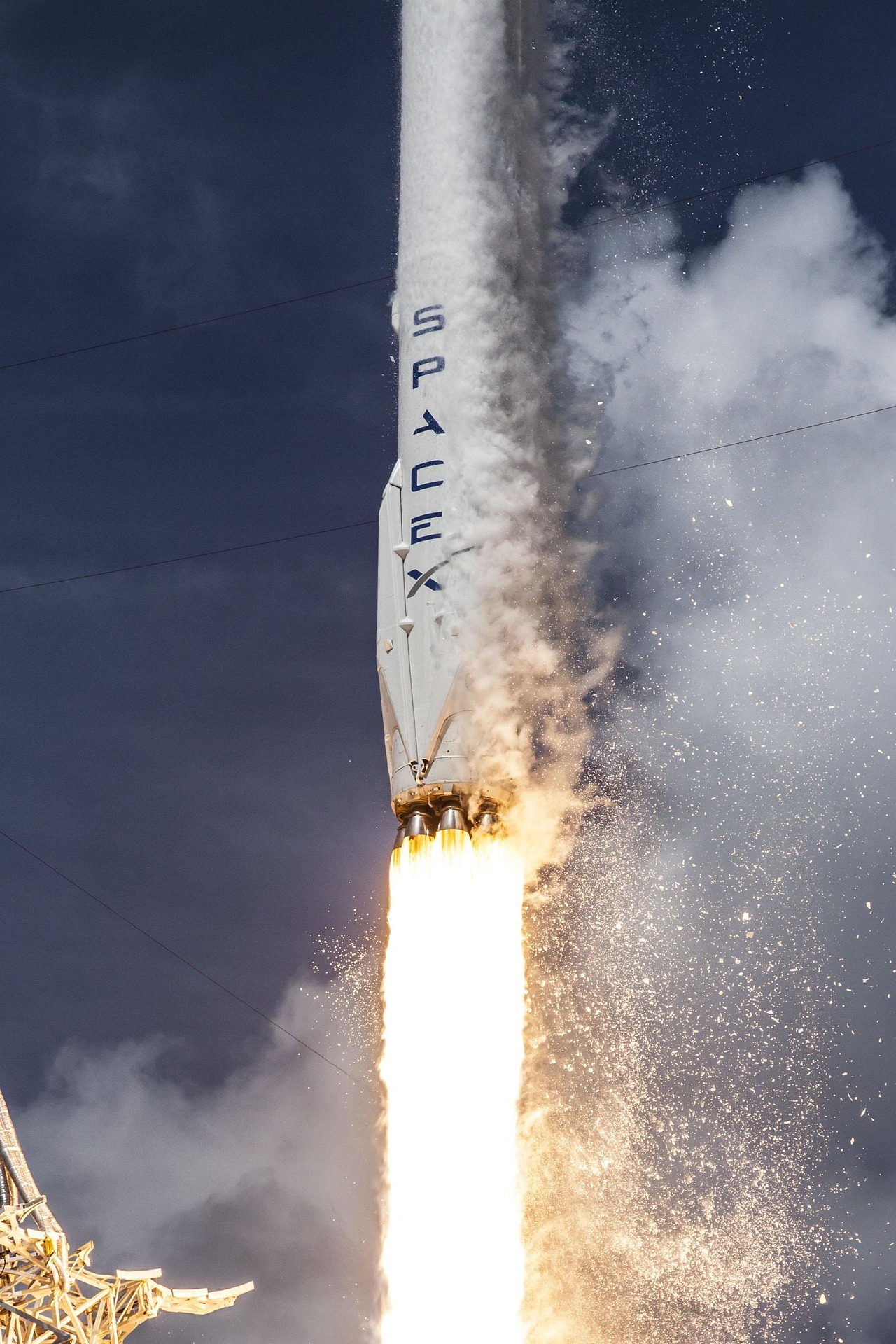
Image Source: SpaceX Official FlickrTo justify its massive valuation, SpaceX has a packed schedule of high-margin operational catalysts over the next 24 months that investors must track carefully:
- Q3 2026: Fast-Track Index Inclusion: Expected passive inflows from major benchmark tracking funds as SPCX hits liquidity and capitalization requirements for the Nasdaq-100 and S&P 500.
- Q1 2027: Starlink Direct-to-Cell Commercialization: Global rollout of unmodified smartphone satellite connectivity in partnership with major telecom carriers, unlocking a high-margin consumer subscription model worldwide.
- Q4 2027: Starship Point-to-Point Cargo Services: Initial commercial deployment of Starship for ultra-rapid, continent-to-continent military and premium commercial cargo logistics under 45 minutes.
- Mid-2028: Project Artemis Lunar Mission Support: Major multi-billion-dollar milestone payments from NASA as the Starship Human Landing System (HLS) prepares for uncrewed and crewed lunar landings.
5. The Space Ecosystem: Top 3 Government-Backed Diversifiers
While SpaceX acts as the overarching “Operating System (OS) of the Space Economy,” the following three companies are pure-play infrastructure providers backed by heavy federal spending. To hedge against SPCX’s early volatility, these names demand attention.
- Rocket Lab (Ticker: RKLB): Widely regarded as SpaceX’s most viable commercial competitor. Backed by the U.S. Space Force and NASA, its upcoming medium-lift “Neutron” vehicle makes it a premier beneficiary of expanding federal launch budgets.
- Intuitive Machines (Ticker: LUNR): The prime contractor for NASA’s CLPS (Commercial Lunar Payload Services) program. Operating as the premier “logistics hub” for the Moon, its revenue is entirely fueled by non-discretionary government funding, making it highly resilient to economic downturns.
- Redwire (Ticker: RDW): A dominant player in “In-Space Manufacturing” and orbital robotics for the U.S. Army. As global military strategy pivots toward permanent orbital structures, Redwire is uniquely positioned to capture specialized defense spending.
6. Model Portfolio: Designing a Resilient Space Asset Allocation
For individual investors looking to deploy capital into this secular trend, concentration can be highly dangerous due to early price discovery. Below is a professional-grade model asset allocation tailored for a balanced risk-reward profile:
| Asset Allocation | Target Weight | Investment Horizon | Core Strategic Role |
|---|---|---|---|
| SpaceX (SPCX) | 50% | Long-Term (5+ Years) | Core structural anchor; capturing global monopoly profits in satellite data and heavy-lift launch dominance. |
| Rocket Lab (RKLB) | 20% | Medium-Term (3–5 Years) | Tactical alpha generator; pure beneficiary of the small-to-medium payload market and alternative defense launch provider. |
| Intuitive Machines (LUNR) | 15% | Medium-Term (3–5 Years) | Deep-value infrastructure hedge; utilizing long-term government exploration contracts to ensure downside protection. |
| Redwire (RDW) | 15% | Long-Term (5+ Years) | High-upside growth option; capitalizing on the emerging orbital manufacturing sector and deep-space robotics. |
7. Tactical Investor Guide and Conclusion
- The Core Position: For long-term investors aiming to capture the foundational growth of the space-civilization era, accumulating SPCX shares remains the absolute premier vehicle.
- Leveraged Derivatives: 2X leveraged ETFs (Long: SPCU, Short: SNK) are active. However, due to the severe decay caused by volatility drag during choppy market phases, these must be restricted strictly to intra-day tactical trading.
- The Bottom Line: SpaceX’s massive debut is triggering a sector-wide valuation re-rating. Rather than over-concentrating capital into SPCX during its high-volatility price-discovery phase, allocating a portion of capital to RKLB, LUNR, and RDW allows you to ride the same macroeconomic tailwinds with attractive risk-adjusted upside.
Disclaimer: This analysis is for informational purposes only and does not constitute financial advice. Always conduct your own due diligence before making investment decisions.